

He doesn't look like someone who would do that
Tending the full spectrum of humanity within us

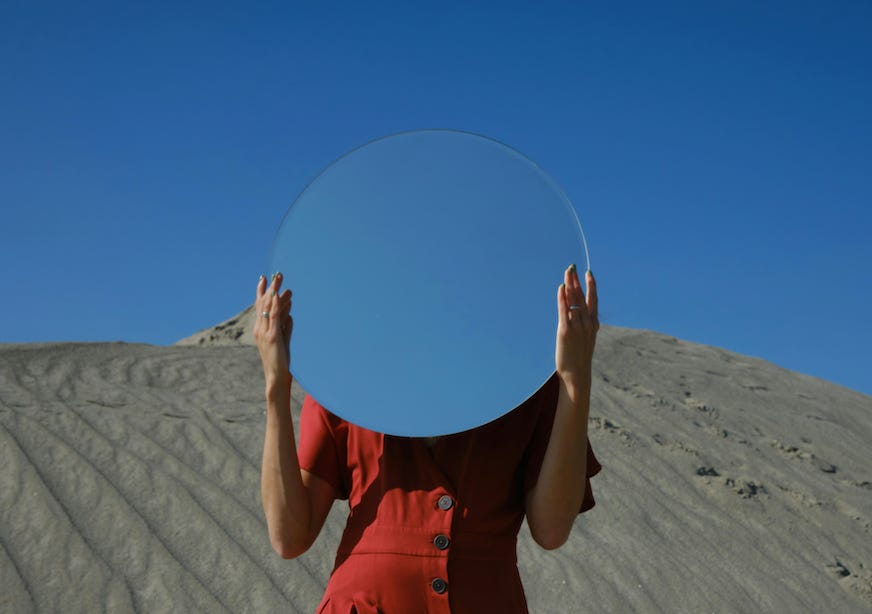
A way of orienting our experience that allows so much pain and suffering to continue is that we like to think we know what somebody is capable of based on how they look.
I’ve heard a man say “C’mon, you don’t believe that stuff… do you? Trump doesn’t even look like a rapist.”
Or sometimes it’s the opposite: someone who has done heinous things gets doxxed and suddenly everyone can see it. “That look in their eye.” Where was all of this clarity when that man was raping children for decades?
What does somebody who would do that look like?
My own father? He went to work Monday through Friday for 45+ years. He came to parent teacher conferences. He came to every single high school football and basketball game I cheered at. He was there on move-in day at college. No one ever commented, at least to me, that he looked like a child rapist. He goes to the grocery store, gets gas for his car, and walks the dog hidden in plain sight. Just a regular looking dude. Who raped his daughter for the first eight years of her life.
When a healthcare CEO was shot at point-blank range on the street in Manhattan, and the alleged suspect’s photo was released: instant nuance. He’s a hot guy. Does Luigi look like a murderer? He has the unique aspect of a double down: a hot guy killed a Bad Man. Or at least a man who was the face of Bad Things– what a hero! (This is all at face-value –pun intended– not even beginning to open any rabbit holes about the entire situation.) I can only imagine how quickly a differently colored man, or even someone with less symmetrical bone structure or idealized physique would have been labeled a domestic terrorist. How quickly Trump would have engaged the American public in hating everyone from the nation he represented, threatening to deport him back to where he came from, no matter if he was born in the US or not. I’ve heard exactly zero mention of the possible congruency between his Sicilian roots and Mafia violence, but I digress.
When we say “they look like someone who would/n’t do that,” it’s a time when folks’ racism, classism, and all sorts of other isms and phobias rise to the surface very quickly. The other-ing begins: that person is a different color, race, gender, sexual orientation, or religion than me. That person has a different worldview or differing political beliefs than me. That person is different from me. Therefore it is easy for me to dehumanize them. At times, the dehumanization is not only easy, but justified and confused for valid through the fog of fear and righteousness. We try to externalize our safety. It doesn’t work because safety, true safety, is internal. Anything else is a posture, a strategy.
With the other than humans– plants, animals, elements– we can look at someone, a viper, scorpion, belladonna, crocodile, fire, raging flood waters, and say oh, wow, that one is dangerous. They have a really strong boundary, and they’re going to protect their boundary with something that actually might hurt me. I can look at them and then I can act accordingly.
It’s different with humans, because no matter what we look like, we all are capable of the full spectrum of humanity. From the most exalted, amazing displays of embodied love and compassion all the way down to the most unspeakable, horrific things.
Let me say that again: we are all capable of the full spectrum of humanity. My teacher, Dr. Daniel Foor, refers to the “apothecary of poisons” that we must tend to in our hearts. It’s a metaphor one can really roll with: it’s a way to consciously hold and live with all of the energies, harmful and otherwise, in the world within us. Little jars of hate, violence, judgment, ignorance, attachment, aversion, pride, and jealousy. We keep the lids on tight, but we know exactly where they are at any time. Oh yeah, I know that poison. I’ve taken a drop of it (or a whole jar) at times. I know what activates that in me. I also know exactly where I store the antidote to that. I’m not going to get seduced by that energy. It is me, and it is inside of me.
If that isn’t part of your practice, well I invite it to become part of your practice of being human. To sit with your well and bright ancestors and ask them: what would you show me about how to maintain all of this? What am I missing? This is shadow work, as the cool kids say. It’s an essential part of becoming an emotionally mature adult. It’s essential to real relating. The only antidote to us projecting these energies outward, is to deal with them internally.
The truth is safety is not guaranteed.
It is not a given.
Relating with other humans (and other-than-humans for that matter) is inherently dangerous.
That doesn’t mean that we shouldn’t relate. It’s by design. It’s not a flaw. Ya gotta lean in. Ya gotta risk being hurt, it’s part and parcel of being known. Of being alive. Of being loved.
Sexual abuse is the water we swim in. There is no population of people who are untouched by this energy. There is no population of people who are not perpetrators of sexual violence. There is no population of people who are not victims of sexual violence.
Trust me. I have sought to find the group to feel “safe” with.
Here’s a hard to swallow pill: I have lost count of the number of survivors I have sat across and listened to their story about how their own mother was their molester. Another: I have lost count of the number of straight, cis-gendered men I have sat across from and heard their stories of sexual abuse.
The Me Too movement created a social layer of protection or buffer for survivors to step forward. It brought this all into everyday conversations. It began to chip away at the taboo of sharing your lived experience, if your lived experience included sexual abuse. What a blessing.
With that, came a slew of Known Predators. These images we see of perps (officially legally convicted or otherwise) are leading us as witnesses. There is already a bias. Here is a photo of a Bad Person. It’s created a bit of smoke and mirrors. A cloud of confusion. We know what Bad People look like, now. And more than that: we know some details about them.
Common collective assumptions about sexual perpetrators:
Democrats
Republicans
Men
Rich men
Rich Democratic men
Rich Republican men
Old men
Young men
The answer is yes, and.
If I showed you 20 mug shots, and 20 photos of drivers licenses or passports and asked you to identify who the mug shots were, you wouldn’t be very successful (I looked to see if this study had been done and hadn’t found anything. If you know of something, or similar, please tell me!) (Or, if you have, or know someone who has, the capacity to fund a study like this, please let me know.)
There are the cases that get the airtime. Cases it’s nearly impossible to escape the details of. Cases that are talked about with such frequency, by so many, a stereotype begins to harden. This stereotype is yet another collective attempt to convince ourselves of safety. That is what a Bad Person looks like! A rapper. A very wealthy business man. A teen boy with curly blonde hair and blue eyes. An old, bald, overweight priest. A person who wears that kind of glasses. What about all of the cases that we’ll never know about? What about all of the people who perpetrated sexual harm and no one can or will or would report it? What do they look like? Who sent them silly little birthday cards? Who sat next to them at work everyday for a decade?
It’s not so simple.
It’s not neat and tidy.
It’s not: here is a list of the 5 attributes that you should look for physically to determine if someone is a sexual predator.
What is required of us?
We must create relational safety so that survivors can share their stories. It is one of the things that I am most passionate about: story as an emergency. Survivors of sexual abuse are the ones best suited to remind us of what horrors we are capable of. We must listen, even if it is hard to do so or makes us uncomfortable.
This relational safety is different from the defensive and survival strategies I mentioned earlier. It’s safety created by relatedness. Safety in relatedness. Creating the culture within our relationships where the body has an experience of being able to actually relax. It is an ongoing process, constantly creating this experience. That no matter what is said, what is shared, no one is going anywhere. It can be exhausting for both parties as it is being built because it will constantly be tested. The edges are always evolving and being found. Is this trustable? What if I do this? What if I say this? It’s not just letting someone walk all over you, or subjecting yourself to endless abuse. It’s admittedly a much more advanced relational practice than most people have ever encountered. It’s unconditional love.
We must also create relational safety so that perpetrators can share their stories. This feels unprecedented in modern times. I’ve not come across many stories of someone saying: I did this. This is how I did it. This is why I did. Or even to say this is what I did, and I really don’t know why, but I am willing to look at it. Instead, at “best” we lock them up in prison and call that justice. I don’t have a blueprint for this. I am clear that this is absolutely not where my focus is in this life. My focus in this life is on survivors. The kicker? Most perpetrators are survivors. It’s not lost on me.
Start to notice where you make assumptions (or confirm your bias) with physical appearance. What happens in your body when you pass someone on the street that appears to be the “same” as you? What happens in your body when you pass someone on the street that appears to be “different” than you? Start to see if there can then be a pause, a beat, a moment before the once-automatic idea comes in: they look like someone who would/n’t do that. See if instead you can create the space for: yes that is a human, they are capable of it all, and so am I. Start to get curious about the “apothecary of poisons” within your own heart. Are the lids on the jars? Where are the antidotes stored? Not sure yet? Can you ask your vibrant ancestors for support? Start to create the spaciousness within a relationship where that person can feel the safety in your relatedness. It’s not through personal effort that anything will shift collectively. It’s through leaning into the web of relatedness we all inherently share.
It’s almost Ancestor Season/Spooky Season/October…
join me at an upcoming workshop if you’re local to New England:
Ancestral Lineage Healing for beginners
A primer for skeptics, seekers, and the ancestor-curious
Are you ancestor-avoidant? Frustrated by your ancestors? Maybe you’re up to your eyeballs in healing modalities, but still drawn to understand the influence of the dead on our lives. Maybe you’ve been on a path, and you’re encountering work that feels hollow or leaves you yearning for something more grounded. This super accessible, beginner-friendly, workshop is for you.
Ancestral Healing Practitioner and writer Ashley Waverley will break down the basics of ancestral healing (the general concept) and Ancestral Lineage Healing (the method). The gathering will be very “why, how, what”—a true primer on the nature of the work, what you stand to gain if you venture in, what’s required of you, and how it’s different (or not) from what you think it is.
What to expect:
Some teaching
Q + A time
Guided ritual meditation
We’ll be sitting in chairs
Please bring a notebook and pen to take notes
(The same workshop will be held at each location.)